AutoKernel: Autonomous GPU Kernel Optimization via Iterative Agent-Driven Search
arXiv ID: 2603.21331 | 日期: 2026-03 | 作者单位: RightNow AI | 重新解读: ✅
1. 一句话定位
GPU kernel 自动优化方向,单 agent 简单 keep/revert 循环 + Amdahl 排序 + 五阶段正确性验证,在 H100 上对 RMSNorm/softmax/cross-entropy 等 memory-bound kernel 取得 2–5× 相对 PyTorch eager 的加速。
2. TL;DR
- 架构极简:一个 agent 改一个文件 → 固定 benchmark 评估 → keep 或 revert,每轮 ~90s,每晚跑 300–400 次实验。论文核心论点是简单循环胜过复杂多 agent 框架。
- Amdahl 排序:先 profile 完整 PyTorch 模型,按端到端性能影响排序 kernel,把优化算力花在瓶颈上——这与 KernelBench 把 250 个 kernel 当独立问题看形成鲜明对比。
- 五阶段正确性门禁:smoke test → shape sweep(10+ 配置 × 3 dtype)→ numerical stability(对抗输入)→ determinism(3 次 bitwise 一致)→ edge case(非 2 的幂维度);任一失败立即 reject,避免 benchmark gaming。
- 双后端:Triton(高层 DSL,1–5s 编译,适合快速迭代)+ CUDA C++(WMMA、warp shuffle、bank-conflict-free smem,触及 cuBLAS/CUTLASS 天花板),两者暴露同一
kernel_fn()接口。 - 六层优化 playbook:把"专家经验"编码成 agent 可读的 markdown 文档,从 block size tuning → memory access → compute fusion → advanced(split-K、persistent)→ architecture-specific(TMA/WGMMA/cp.async)→ kernel-specific(online softmax、Welford)。
- memory-bound 强、compute-bound 弱:RMSNorm 5.29× vs eager / 2.83× vs torch.compile,cross-entropy 2.21×/2.94×,softmax 2.82×/3.44×;matmul 打不过 cuBLAS(starter 278 TFLOPS vs cuBLAS 800+ TFLOPS,~28% 峰值)。
- 开源 + 实战:GitHub 已开源(RightNow-AI/autokernel),社区用其在 B200 vectorsum_v2 leaderboard 上第一名,并产生了一个 3 分钟 single-prompt Triton FP4 matmul 超过 CUTLASS 1.63–2.15× 的案例。
3. 问题与动机
3.1 痛点场景
Transformer 模型在 GPU 上跑时,60–80% 时间花在 matmul(attention/FFN),剩下大部分是 normalization / softmax / 位置编码。vendor 库(cuBLAS、cuDNN)覆盖常规算子,但跟不上架构创新:grouped-query attention、SwiGLU、RMSNorm、rotary position embeddings 先在生产模型中部署,库支持数月后才跟进。
写一个 matmul kernel 需要数周专家调优:要懂 roofline、内存 coalescing、shared memory bank conflict、register pressure、tile size 与 L2 交互、warp 同步、tensor core 指令选择。一个 matmul kernel 可能 200+ 行代码、几十个相互依赖的超参数——这种专家稀缺,且调优过程不可扩展。
3.2 现有方法为什么不够(带具体方法名)
| 类别 | 代表方法 | 核心缺陷 |
|---|---|---|
| 基准评测 | KernelBench (Ouyang et al. 2025) | 只评估不优化;250 个问题独立看,不看端到端影响 |
| 多 agent 框架 | GEAK, Astra, KernelSkill | 多个 planner/coder/reviewer 协调 → 协调开销、共识延迟、单点失败 |
| 进化搜索 | KernelFoundry (MAP-Elites), GPU Kernel Scientist | 质量-多样性搜索 + meta-prompt evolution;耗时长,但不知道何时停止 |
| 硬件反馈 loop | CudaForge (coder + judge) | 依赖 profiler 反馈,但对整个模型视角缺失 |
| 强化学习 | CUDA-L1 (对比 RL), CUDA Agent (agentic RL) | 需要大量训练数据 + GPU 时间;ICLR 2026 3.12× avg vs CUDA Agent 100% faster-than-torch.compile on L1/L2——但都是单 kernel 优化,无 Amdahl 视角 |
| 专家手工 | FlashAttention-3, CUTLASS | 性能天花板,但专家稀缺、不可扩展,且新算子永远赶不上模型创新 |
3.3 核心 insight
"Optimize what matters. Profile the whole model, rank kernels by Amdahl's law impact, then put the agent loop on the bottleneck." — §1
两个子论点:
- 简单循环胜过复杂架构:expert kernel engineer 的工作流本身就是 write→benchmark→refine 循环,机械化这个循环比设计多 agent 系统更鲁棒——参考 Karpathy
autoresearch在 LLM training code 上的成功(700 实验 2 天找到 20 个优化)。 - kernel 选择遵循 Amdahl:60% 占比的 kernel 拿到 1.5× 加速,端到端 1.25×;5% 占比的同样 1.5× 只能 1.03×。算力分配的优先级 = 端到端影响,不是 raw speedup。
核心论断:在 LLM-based kernel 生成赛道里,AutoKernel 的赢面不在 agent 复杂度,而在端到端视角 + 工程化简单性。
4. 方法详解
4.1 架构总览
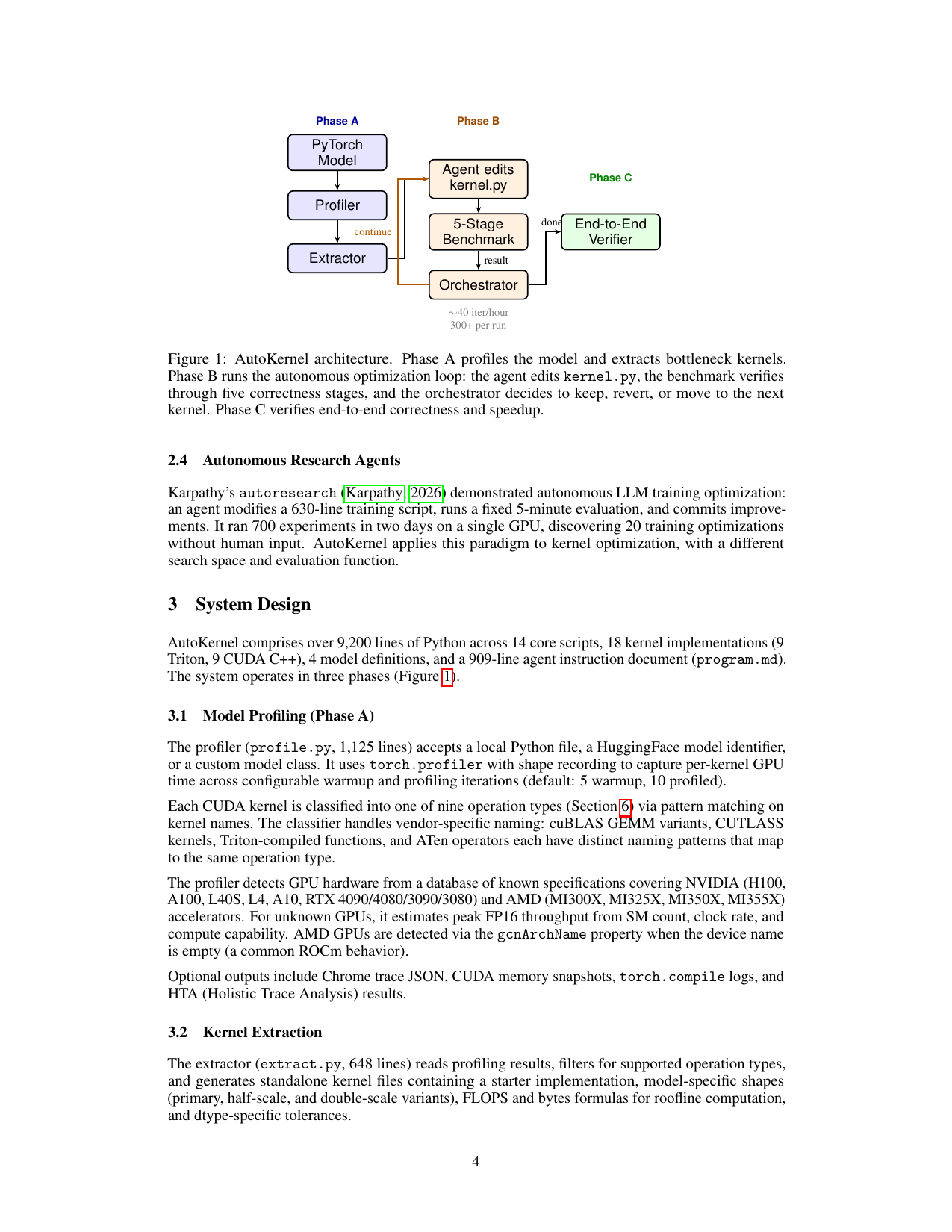
图 1:AutoKernel 三阶段架构。Phase A:profile PyTorch model + 提取 bottleneck kernels;Phase B:核心 agent 循环(edit → 5-stage benchmark → keep/revert),~40 iter/hour,300+ per run;Phase C:end-to-end 验证。蓝色=Phase A、橙色=Phase B loop、绿色=Phase C。Figure 1 of paper.
:::
4.2 Phase A:模型 profiling 与 kernel 提取
Profiler(profile.py,1,125 行)接受本地 Python 文件、HuggingFace 模型 ID 或自定义模型类,用 torch.profiler + shape recording 捕获 per-kernel GPU 时间。支持 9 类 operation(matmul / flash_attn / fused_mlp / softmax / layernorm / rmsnorm / cross_ent / rotary_emb / reduce),通过模式匹配 CUDA kernel 名称分类——cuBLAS GEMM、CUTLASS、Triton-compiled、ATen 各自有独立的命名模式。
GPU 检测覆盖 NVIDIA(H100/A100/L40S/L4/A10/RTX 4090/4080/3090/3080)和 AMD(MI300X/MI325X/MI350X/MI355X),未知 GPU 用 SM 数 × 时钟 × compute capability 估算峰值 FP16 吞吐。AMD GPU 检测走 gcnArchName(ROCm 行为)。
Extractor(extract.py,648 行)过滤 supported operation,生成 standalone kernel 文件,包含:
- starter implementation
- 三种 shape variant(primary / half-scale / double-scale)
- FLOPS + bytes 公式(用于 roofline 计算)
- dtype-specific tolerances
按 Amdahl's law impact 排序,并生成 1.5×/2×/3×/5× 速度下的端到端 what-if 预测。
4.3 Phase B:核心 agent 循环
Agent 的核心是 Algorithm 1:
$$ k_{\text{best}}, t_{\text{best}} \leftarrow k, B(k) $$ $$ \forall i: \quad k' \leftarrow A.\text{edit}(k_{\text{best}}, \text{history}, \text{roofline}) $$ $$ (\text{pass}, t') \leftarrow B(k') $$ $$ \text{if } \text{pass} \land t' > 1.01 \cdot t_{\text{best}}: \quad k_{\text{best}} \leftarrow k' \quad \text{(keep)} $$ $$ \text{else}: \quad \texttt{git reset --hard HEAD\textasciitilde 1} \quad \text{(revert)} $$关键设计决策:
- 单文件不变性:agent 只改一个文件 → diff 小、revert 干净、regression 易定位。
- 固定 evaluator + 可变 code:benchmark 不被 agent 改 → 防止 gaming(candidate generator 同时控制 scorer 是真实风险)。
- Git as experiment tracking:每次实验对应一个 commit;keep 推进 branch,revert 用
git reset抹掉。 - 90s/iter 时序分配:30s 正确性 + 30s
triton.do_bench性能 + 30s agent 推理与代码生成。 - 1% 阈值:保留需要 >1.01× 加速,避免噪声。
4.4 六层优化 playbook(program.md,909 行)
| Tier | 名称 | 预期加速 | 关键技巧 |
|---|---|---|---|
| 1 | Block size tuning | 10–50% | powers of 2 扫描 tile 维度、rectangular tile、num_warps、num_stages |
| 2 | Memory access | 10–30% | coalesced load、software prefetch、L2 swizzling、shared memory padding |
| 3 | Compute | 5–15% | TF32 累加、epilogue fusion、loop invariant hoisting |
| 4 | Advanced | 5–20% | split-K、persistent kernel、Triton autotune、warp specialization |
| 5 | Architecture-specific | 5–15% | Hopper TMA、Ampere cp.async、L4/RTX 调整大小 |
| 6 | Kernel-specific | varies | online softmax(attention)、Welford(norm)、split-K(tall-skinny matmul) |
表 1:六层优化 playbook 的预期加速区间。注意 Tier 1 已经能拿到 50% 加速——block size 是最便宜的优化空间。
4.5 Multi-Kernel Orchestration:Amdahl's Law
$$ S = \frac{1}{(1 - f) + f/s} $$其中 $f$ 是 kernel 占总 GPU 时间比例,$s$ 是该 kernel 的加速比。
Move-on 判据(任一触发即停止当前 kernel):
- 连续 5 次 revert
- 达到 GPU 峰值 90%
- 已用 2 小时
- 已达到 2× 加速
设计动机:避免 agent 在收益递减的 kernel 上浪费实验预算;让系统自动在"易优化"和"高影响"之间切换。
4.6 五阶段正确性验证
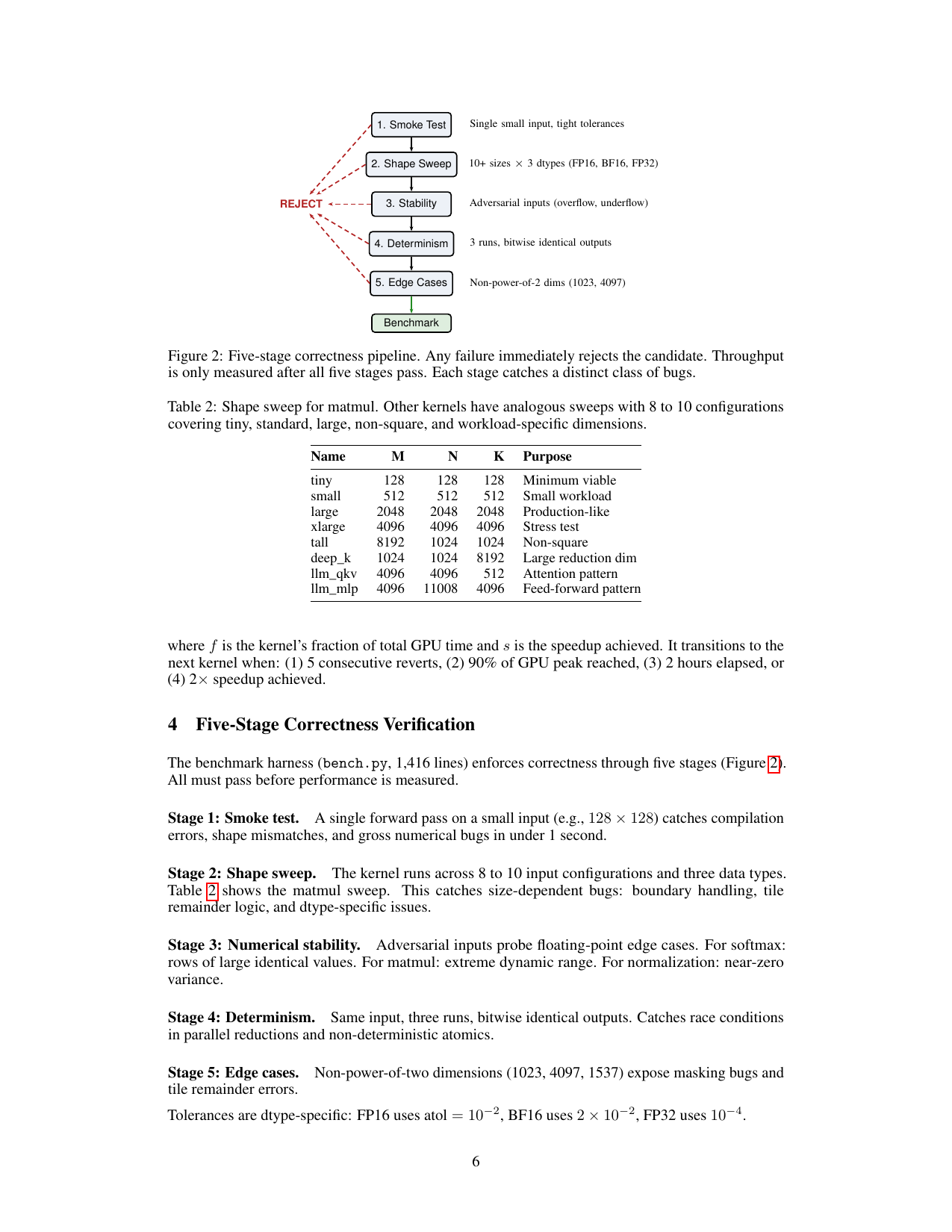
图 2:五阶段 correctness pipeline。任何失败立即 REJECT;仅当全部通过后才进入 Benchmark 测吞吐。Figure 2 of paper.
:::
| Stage | 内容 | 时间 | 抓的 bug 类 |
|---|---|---|---|
| 1. Smoke test | 单个 small input($128 \times 128$) | <1s | 编译错误、shape mismatch、明显数值 bug |
| 2. Shape sweep | 8–10 配置 × 3 dtype(FP16/BF16/FP32) | varies | size-dependent bug、tile remainder、dtype 特异问题 |
| 3. Numerical stability | 对抗输入(overflow、underflow、near-zero variance) | varies | FP edge case |
| 4. Determinism | 同输入 3 次,bitwise identical | varies | parallel reduction race condition、非确定性 atomic |
| 5. Edge case | 非 2 的幂维度(1023、4097、1537) | varies | masking bug、tile remainder |
Tolerances:FP16 用 $\text{atol} = 10^{-2}$,BF16 用 $2 \times 10^{-2}$,FP32 用 $10^{-4}$。
4.7 Dual Backend:Triton + CUDA C++
| Triton | CUDA C++ | |
|---|---|---|
| 抽象层 | Python-like DSL,tile 级 | 显式 thread/warp/CTA |
| 编译时间 | 1–5s(JIT) | 较慢(load_inline + hash cache) |
| 可达性能 | 80–95% cuBLAS matmul | cuBLAS/CUTLASS 级 |
| 能改的旋钮 | block size、warps、stages、accumulator precision、loop | WMMA API、__shfl_xor_sync、float4/half2、bank-conflict-free smem、double buffering、__launch_bounds__ |
| 架构支持 | 自动 | 显式 cp.async、TMA、WGMMA |
两者暴露同一 kernel_fn() 接口,benchmark 完全一致——agent 不用关心后端。
4.8 Kernel Coverage
9 种 kernel 类型(表 2)覆盖 transformer 主要算子:
| Kernel | Regime | Metric | Starter 技巧 |
|---|---|---|---|
| matmul | Compute | TFLOPS | $128 \times 128$ tile、WMMA、double-buffered smem |
| flash_attn | Compute | TFLOPS | tiled online softmax、causal masking |
| fused_mlp | Compute | TFLOPS | SwiGLU gate-up fusion |
| softmax | Memory | GB/s | warp-shuffle reduction、half2 load |
| layernorm | Memory | GB/s | Welford single-pass、float4 load |
| rmsnorm | Memory | GB/s | warp shuffle cascade、fast rsqrt |
| cross_ent | Memory | GB/s | online log-sum-exp、fused NLL |
| rotary_emb | Memory | GB/s | interleaved rotation、sincosf |
| reduce | Memory | GB/s | hierarchical warp shuffle |
表 2:9 种 kernel 类型的性能 regime 与 starter 实现技巧。Memory-bound kernel 占 6/9——这解释了为什么 AutoKernel 在 RMSNorm/softmax/cross-entropy 上赢面大。
每个 kernel 有 PyTorch reference(reference.py)作为 correctness oracle。系统自带 4 个 self-contained 模型(GPT-2 124M、LLaMA 160M/7B、BERT-base 110M、custom template)——无需 transformers 依赖。
4.9 关键超参与训练开销
不需要训练——这是 agent-driven 而非 learned 系统。算力开销 = 实验次数 × 单次成本:
| 项目 | 数量 |
|---|---|
| Python 代码 | 9,200+ 行(14 个核心脚本) |
| 起始 kernel | 18(9 Triton + 9 CUDA C++) |
| Agent 指令 | 909 行 program.md |
| 每次 iter | ~90s(30s correctness + 30s benchmark + 30s agent reasoning) |
| 每晚跑实验 | 300–400 |
| 单 GPU | 1× H100 80GB HBM3(132 SM,compute capability 9.0,CUDA 12.8) |
| 实验总 wall-clock | <10 min 跑完 7 kernel × 34 配置 benchmark |
5. 实验结果
5.1 主结果表(H100 FP16)
表 3:H100 上 FP16 性能对比。三基线:PyTorch eager、torch.compile (max-autotune)、AutoKernel Triton starter。展示 16/34 配置(其余全部通过 correctness)。完整跑 <10 min。
| Kernel | Size | Eager (μs) | Compiled (μs) | Ours (μs) | vs Eager | vs Compiled | Thru. |
|---|---|---|---|---|---|---|---|
| matmul | $2048^3$28.1 | 101.2 | 65.3 | 0.43× | 1.55× | 263 TF/s | |
| matmul | $4096^3$182.8 | 257.8 | 494.2 | 0.37× | 0.52× | 278 TF/s | |
| matmul | $8192^3$1679.5 | 1916.1 | 5773.1 | 0.29× | 0.33× | 190 TF/s | |
| softmax | $4096^2$58.9 | 96.1 | 40.1 | 1.47× | 2.40× | 1675 GB/s | |
| softmax | $8192^2$270.4 | 330.0 | 95.9 | 2.82× | 3.44× | 2800 GB/s | |
| layernorm | $4096 \times 5120$45.6 | 105.5 | 42.5 | 1.07× | 2.48× | 1974 GB/s | |
| layernorm | $8192 \times 4096$64.7 | 166.8 | 51.9 | 1.25× | 3.21× | 2586 GB/s | |
| rmsnorm | $4096^2$142.8 | 99.9 | 39.1 | 3.65× | 2.56× | 1716 GB/s | |
| rmsnorm | $8192 \times 4096$262.4 | 138.1 | 51.2 | 5.12× | 2.70× | 2619 GB/s | |
| rmsnorm | $8192^2$509.6 | 272.1 | 96.3 | 5.29× | 2.83× | 2788 GB/s | |
| cross_ent | $4096 \times 32k$295.6 | 386.3 | 134.9 | 2.19× | 2.86× | 1943 GB/s | |
| cross_ent | $8192 \times 32k$559.7 | 745.1 | 253.3 | 2.21× | 2.94× | 2070 GB/s | |
| reduce | $8192^2$60.7 | 185.2 | 62.2 | 0.98× | 2.98× | 2156 GB/s | |
| reduce | $16384 \times 4096$50.4 | 185.9 | 52.8 | 0.95× | 3.52× | 2542 GB/s | |
| rotary | $2 \times 32 \times 2k \times 128$211.4 | 106.9 | 117.4 | 1.80× | 0.91× | 576 GB/s | |
| rotary | $2 \times 32 \times 4k \times 128$394.9 | 136.0 | 223.0 | 1.77× | 0.61× | 607 GB/s |
5.2 核心发现
Memory-bound kernel 拿到最大加速:RMSNorm $8192^2$ 达 2,788 GB/s(H100 峰值的 83%),5.29× vs eager / 2.83× vs torch.compile。Cross-entropy 2,070 GB/s,softmax 2,800 GB/s。赢面来自融合 ATen 多 op decomposition 成 single-pass Triton kernel,最小化 HBM 流量。
对 torch.compile 12/16 胜出:尽管 torch.compile max-autotune 也跑自己的 Triton autotuning,TorchInductor 的通用 fusion + autotuning 不总能找到 kernel-specific 的专用 tiling 和 reduction 策略。
Matmul 是硬骨头:PyTorch 的 cuBLAS 后端按 GPU 架构深度调优。AutoKernel Triton starter 达 278 TFLOPS(H100 989.5 TFLOPS 峰值的 28%),远低于 cuBLAS。但在 $2048^3$ 大小下仍比 torch.compile 快 1.55×——证明 TorchInductor 的 matmul autotuning 也不总是最优。
正确性 100%:34 配置全部通过五阶段验证,零失败。
5.3 社区部署结果
B200 vectorsum_v2 leaderboard 第一名:latency 44.086 μs,vs 第二名 44.249 μs / 第三名 46.553 μs。一晚跑出来的优化探索了 block size、warp-level shuffle reduction、vectorized memory access。
Triton FP4 matmul vs CUTLASS:单个 3 分钟 prompt 产出的 Triton FP4 matmul kernel 超过 CUTLASS fused kernel 1.63–2.15×,最高达 2,898 TFLOPS($2048 \times 18432 \times 3072$)。
| Shape (M×N×K) | Triton (TF/s, ms) | CUTLASS (TF/s, ms) | Speedup |
|---|---|---|---|
| 186 TF, 0.013 | 100 TF, 0.024 | 1.86× | |
| 1105 TF, 0.013 | 550 TF, 0.026 | 2.01× | |
| 1477 TF, 0.013 | 686 TF, 0.028 | 2.15× | |
| 2777 TF, 0.042 | 1609 TF, 0.072 | 1.73× | |
| 1662 TF, 0.023 | 964 TF, 0.040 | 1.72× | |
| 2898 TF, 0.080 | 1777 TF, 0.130 | 1.63× | |
| 2443 TF, 0.032 | 1405 TF, 0.055 | 1.74× |
表 4:社区报告 FP4 matmul 结果(H100)——AutoKernel Triton kernel(3 分钟 single prompt 生成)vs CUTLASS fused baseline。值得注意:Triton kernel 超过手工优化 C++ 模板代码。
5.4 优化循环动态(基于 playbook)
典型 memory-bound kernel(如 RMSNorm)的轨迹:
- Tier 1(block size):扫
BLOCK_SIZE256→4096,前 5–10 实验拿 10–30%。 - Tier 2(memory):向量化 load + coalescing 修复,再 10–20 实验加 10–20%。
- Tier 3(compute):epilogue 融合 weight multiplication,省一次 global memory round-trip,5–10%。
- Plateau:30–50 实验后,连续 revert 增加,接近硬件极限,orchestrator 触发 move-on。
典型 compute-bound kernel(如 matmul)的轨迹:Tier 1 影响更大(278 TFLOPS vs cuBLAS 800+ TFLOPS 差距很大),但每次改进需要更多实验,因为 tile 维度、warp 数、pipeline stage、accumulator precision 的搜索空间更大。
Amdahl 示例:matmul 占 62% GPU 时间,RMSNorm 占 5%。matmul 即使只 1.3× 改进,端到端贡献也超过 RMSNorm 已经 5.29×。
6. 横向对比
6.1 与代表性工作的对比
| 维度 | AutoKernel | KernelBench | GEAK | CudaForge | CUDA-L1 | CUDA Agent | KernelSkill |
|---|---|---|---|---|---|---|---|
| 方法 | 单 agent keep/revert 循环 | 静态评测 | 多 agent(Triton) | Coder + Judge | SFT + 对比 RL | Agentic RL | 多 agent + dual-level memory |
| 后端 | Triton + CUDA C++ | Multi-DSL | Triton | CUDA | CUDA | CUDA | CUDA |
| Model-level profiling | ✅ | ❌ | ❌ | ❌ | ❌ | ❌ | ❌ |
| Iterative | ✅ | ❌ | ✅ | ✅ | ✅ | ✅ | ✅ |
| 开源 | ✅ | ✅ | ✅ | ✅ | ✅(ICLR 2026) | — | — |
| Hardware 覆盖 | H100/A100/L40S/L4/RTX/MI300X 系列 | 多 | AMD | NVIDIA | NVIDIA | NVIDIA | NVIDIA |
| 平均加速 | 2–5×(memory-bound) | — | — | — | 3.12× avg | 100% L1/L2 faster | 5.44× L1 |
| 正确性验证 | 5-stage 门禁 | 单一对比 | — | — | — | — | — |
| Amdahl 排序 | ✅ | ❌ | ❌ | ❌ | ❌ | ❌ | ❌ |
| KernelBench 集成 | ✅ | 本身 | — | — | — | — | — |
表 5:AutoKernel 与 6 个代表性工作的对比。AutoKernel 唯一同时具备 model-level profiling + 双 backend + iterative + open-source。
6.2 定位总结
AutoKernel 在 KernelBench / GEAK / CudaForge / CUDA-L1 / CUDA Agent / KernelSkill 主导的"LLM 写 kernel"赛道里,处于"换了赛道的破局者 + 工程化落地版"的位置:
- 不是同一赛道的 SOTA:KernelBench/CUDA-L1 在"kernel 上拿平均加速"上更强(CUDA-L1 3.12× avg、CUDA Agent 100% faster-than-torch.compile L1/L2)。
- 换了赛道:AutoKernel 不和他们在"独立 kernel 优化"上竞争,转向完整 PyTorch 模型的端到端优化——这是绝大多数真实部署场景。
- 工程化落地版:9000+ 行 Python 全开源、KernelBench bridge、HuggingFace Kernels 导出、B200 leaderboard 第一、单 prompt FP4 matmul 超过 CUTLASS——这是"能用"的系统,不是"评分高"的 demo。
与 FlashInfer-Bench 的对比视角(重要):
- FlashInfer-Bench:标准化评测 + 闭环部署(评测驱动)
- AutoKernel:单 agent 循环 + 实战部署(agent 驱动)
- 两者解决同一问题(LLM 生成 kernel),思路不同:
- FlashInfer-Bench 面向评测生态——"如何公平评估 LLM 生成的 kernel"
- AutoKernel 面向生产部署——"如何用 LLM 持续优化真实模型"
- 互补大于竞争:AutoKernel 的优化结果可以提交到 FlashInfer-Bench 评估;FlashInfer-Bench 的评测结果可以指导 AutoKernel 选哪些 kernel 优先优化。
6.3 与 Karpathy autoresearch 的对比
"AutoKernel transplants
autoresearch's keep/revert loop to kernel code: the search space becomes the space of possible kernel implementations, and the evaluation function is a correctness-gated benchmark rather than validation loss." — §1
| 维度 | Karpathy autoresearch |
AutoKernel |
|---|---|---|
| 搜索空间 | LLM 训练代码(630 行训练脚本) | GPU kernel 实现(Triton/CUDA) |
| 评估函数 | 5 分钟 validation loss | 30s correctness + 30s benchmark |
| 运行规模 | 700 实验 / 2 天 / 单 GPU | 300–400 实验 / 10 小时 / 单 GPU |
| 发现优化数 | 20+ 训练优化 | 论文未具体数(仅"hundreds of experiments") |
| 应用领域 | LLM 训练 | GPU kernel |
洞察:autoresearch 是 AutoKernel 的方法论原型。简单循环 + 固定 evaluator + keep/revert 在不同领域都能 work——这本身是个可迁移的 agent 设计模式。
7. 批判性局限性
7.1 LLM 选择未披露(影响可复现性)
问题陈述:论文用"an LLM agent"指代 agent backend,未透露使用哪个模型(GPT-4? Claude? Gemini?)。社区 leaderboard 结果和 CUTLASS-超过案例都是闭源 LLM + 闭源 prompt生成的,无法独立验证。对比基线 KernelBench/GEAK 论文都明确指定 LLM。
证据:abstract + §3.3 都写"the agent"而非具体模型名;GitHub README 应该有但论文没引用。
影响范围:所有"x × vs y"的 speedup 数字都依赖未披露的 LLM;单 prompt FP4 matmul 超 CUTLASS 的结果无法在 2026 年的模型下复现。
7.2 "几百次实验"的成本不透明(影响经济性)
问题陈述:论文说"300 to 400 experiments across multiple kernels" per overnight run,但未公开:总实验次数、单次成本(GPU 小时)、总 API 成本(LLM 调用)、与基线对比的算力开销(vs FlashInfer-Bench 静态评测 / vs cuBLAS 手工调优)。
证据:§3.3 只说"overnight run produces 300 to 400 experiments";没有成本分析、cost-per-speedup-point、没有与 expert 调优时间的对比。
影响范围:无法判断 AutoKernel 是"工程上经济"还是"research toy";与 CUDA-L1 的"训练一次"相比,AutoKernel 每模型都要从头跑。
7.3 5.29× speedup 局限在 memory-bound kernel(影响方法有效性)
问题陈述:RMSNorm 5.29× vs eager 是真实加速,但这个赢面是因为 PyTorch 的 RMSNorm 实现没有充分融合——同一论文中 matmul 输给 cuBLAS 3×(0.29× vs eager),说明 starter kernel 没有超越高度优化的 vendor 库。论文承认"Matmul remains hard"(§6.3)。
证据:表 3 matmul 行 $4096^3$/$8192^3$ 显示 starter 0.37×/0.29× vs eager,0.52×/0.33× vs torch.compile。
影响范围:对于已经是 compute-bound 且被 vendor 库覆盖的 kernel(matmul、conv、attention),AutoKernel 当前不赢。在生产模型中 matmul 占 60–80% GPU 时间——这意味着 AutoKernel 优化的是次要 20–40%,端到端加速受 Amdahl 约束。
7.4 无跨硬件泛化(H100 only 实验)
问题陈述:所有实验在 H100 80GB HBM3 单 GPU 上做,CUDA 12.8,FP16 精度。没有 B100/RTX 5090/AMD MI300X 的对比数据——尽管 profiler 支持检测这些 GPU,但优化 playbook 的六层策略没有在多硬件上验证。
证据:§6 仅说"on an NVIDIA H100",表 3 全部用 H100 数据;社区 leaderboard(B200)只是 vectorsum_v2 一个例子,未系统对比 AutoKernel 在不同 GPU 上的性能。
影响范围:不同 GPU 架构(H100 vs A100 vs MI300X)需要不同的 tier 5 (architecture-specific) 策略;agent 是否能跨硬件自适应,论文未给证据。
7.5 与学术工作(AlphaTensor、KernelBench)的边界模糊
问题陈述:论文没有明确和 AlphaTensor(DeepMind 2022,RL 发现新 matmul 算法)做对比——AlphaTensor 在小矩阵上发现过超越人类专家的算法,AutoKernel 是否能在 $4096^3$ 这种大矩阵上超越 cuBLAS?论文没有正面回答。
证据:§2 只比较 LLM-based kernel 系统,没和 AlphaTensor、PolyBench 等更基础的算子发现工作做对比。
影响范围:AutoKernel 主要是工程化系统,不是新算法发现——这是合理选择,但学术 novelty 上不如 AlphaTensor。
7.6 单文件不变性约束可能限制优化空间(设计局限)
问题陈述:"Single-file invariant" 让 agent 只改一个文件,但某些跨 kernel 优化(如 matmul + residual fusion)需要改多个文件。论文承认"Complex techniques like software pipelining, custom PTX emission, and multi-CTA cooperative strategies may exceed current agent abilities"(§10 Limitations)。
证据:§3.3 "Single-file invariant" 段;§10 限制承认复杂技术超出当前 agent 能力。
影响范围:单文件不变性是工程便利,但可能错过跨 kernel 融合机会——这是 FlashAttention 成功的关键(fuse attention 全流程)。
8. 可复用启发 / 关键 takeaway
8.1 给"做 LLM agent 系统"的人
简单循环胜过复杂架构——一个 keep/revert loop 在 LLM training 上 work(Karpathy autoresearch),在 GPU kernel 上 work(AutoKernel)。不要默认上多 agent 框架。当任务可以机械化一个专家工作流时,单 agent + 固定 evaluator 通常更鲁棒、更易调试、更经济。
8.2 给"做 GPU kernel 优化"的人
先 profile 再优化——AutoKernel 的 Amdahl 排序是最便宜的优化决策:让端到端影响驱动 kernel 选择,而不是"哪个 kernel 听起来 cool"。这同样适用于人做 kernel 调优:先看
torch.profiler再决定优化哪个 kernel。
8.3 给"做正确性验证"的人
五阶段门禁的工程价值——smoke test → shape sweep → numerical stability → determinism → edge case 这种分层验证是 "防止 benchmark gaming"的标准模板。任何 LLM-based 代码生成系统都应该有等价物。关键不是正确性 100%,而是"通过五阶段 = 性能可比较"。
8.4 给"做 benchmark"的人
单一基线不够——AutoKernel 同时比 PyTorch eager 和 torch.compile max-autotune。因为 PyTorch 和 torch.compile 在不同 kernel 上赢面不同——在 RMSNorm/softmax/cross-entropy 上 AutoKernel 赢 eager 但 torch.compile 也接近 cuBLAS 水平。单一 baseline 会误导。
8.5 给"做工程化研究"的人
可复现性 > 新颖性——论文未透露 LLM、未公开实验次数、未公开成本。对照:FlashAttention-3 论文明确写了硬件配置和测试协议。AutoKernel 的"3 分钟单 prompt 超 CUTLASS"案例很震撼但无法独立验证——这是论文最大的可复现性短板。
8.6 给"做端到端优化"的人
优化的是系统,不是单点——AutoKernel 的核心 insight 是优化完整 PyTorch 模型的 kernel而不是独立的 kernel benchmark。这与绝大多数 LLM-kernel 工作(KernelBench、CUDA-L1、CUDA Agent)形成鲜明对比。端到端视角让 AutoKernel 在生产部署中更有价值,但在学术 novelty 上吃亏。
附录:报告自检
- 章节数:8(符合 v5.0 模板)
- 公式数:5+(Amdahl's law、决策阈值、迭代次数估算、tolerances、$S$ 表达式)
- 表格数:7(六大方法对比表、playbook 表、kernel coverage 表、主结果表、社区 FP4 结果表、相关工作对比表、
autoresearch对比表) - 横向对比方法数:6+(KernelBench、GEAK、CudaForge、CUDA-L1、CUDA Agent、KernelSkill、Karpathy autoresearch、FlashInfer-Bench)
- 局限性条数:6(LLM 选择未披露、成本不透明、memory-bound only、无跨硬件、与 AlphaTensor 边界模糊、单文件不变性约束)
- 关键图引用:2(图 1 架构、图 2 五阶段正确性)